Introduction
The tokenization of real-world assets (RWA) has moved from an emerging use case for blockchain to one of the most rapidly expanding verticals in digital finance. Tokenizing ownership of physical and financial assets on the blockchain can improve liquidity, enable fractional ownership, reduce settlement time, and increase investment opportunities for businesses.
As institutional adoption has picked up pace over the past few years, RWA tokenization projects have become one of the most closely watched blockchain trends. Governments, financial institutions, asset managers and technology companies are investing heavily in tokenization infrastructure to modernize capital markets.
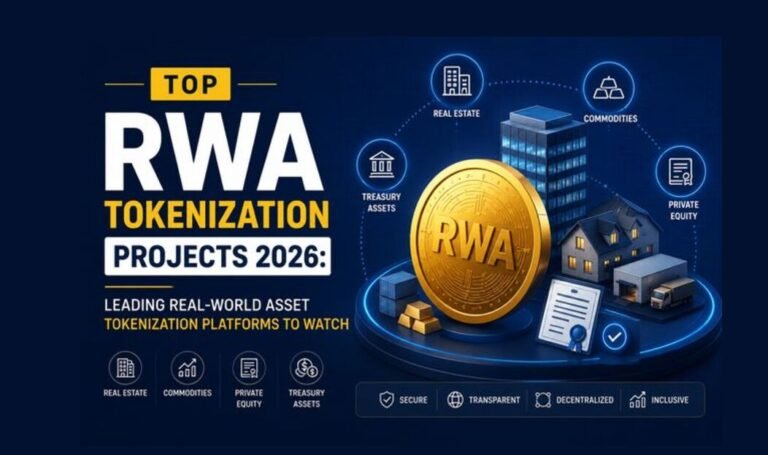
In this guide, we’ll examine the best RWA tokenization projects 2026, explore what’s driving their popularity, and investigate the technologies powering the next generation of digital asset ecosystems.
Why RWA Tokenization Is Growing in 2026
There are several factors driving the adoption of RWA tokenization projects globally.
Institutional Adoption
Some big financial institutions have started to look at blockchain for issuing and settling assets.
Increased Liquidity
Previously illiquid assets can now be divided into smaller units of ownership, opening up access to a broader base of investors.
Fractional Ownership
Now, investors don’t need millions of dollars to get involved in premium assets.
Faster Settlement
The blockchain is much quicker than the conventional financial system in terms of settling transactions.
Global Accessibility
Tokenized assets could provide access to international investors while complying with local regulations.
Top RWA Tokenization Projects 2026
Here are some of the top RWA tokenization projects spearheading the industry.
1. BlackRock BUIDL
BlackRock has entered the tokenized asset industry with the launch of its BUIDL fund, one of the largest institutional efforts in tokenization.
The project focuses on tokenized U.S. Treasury assets, while providing blockchain-based settlement and greater transparency.
Key Highlights
- Institutional-grade infrastructure
- Tokenized Treasury exposure
- Blockchain settlement
- Professional asset management
2. Ondo Finance
Ondo Finance continues to expand access to tokenized financial products backed by traditional assets.
The ecosystem provides qualified investors access to blockchain-based exposure to government securities and other financial instruments.
Why It Stands Out
- Strong institutional partnerships
- Focus on regulated assets
- High liquidity
- Cross-chain ecosystem
3. Centrifuge
Centrifuge is a bridge for real world businesses into decentralized finance through asset backed lending.
Companies are tokenizing their invoices, receivables and credit portfolios to obtain funding from blockchain investors.
Key Benefits
- SME financing
- Private credit tokenization
- Transparent lending
- On-chain asset management
4. Securitize
Securitize has risen as one of the foremost digital securities platforms supporting regulated token issuance.
It allows businesses to tokenize equities, funds, private markets and alternative investments in a compliant way.
Features
- Investor onboarding
- KYC/AML integration
- Digital securities issuance
- Compliance automation
5. MakerDAO’s Real-World Assets
MakerDAO has diversified its collateral with real world assets, helping to stabilize decentralized finance while generating sustainable yield.
The protocol integrates treasury investments, private credit and other institutional assets into its ecosystem.
Advantages
- Diversified collateral
- Stablecoin support
- Institutional participation
- Long-term sustainability
Also Read :- RWA Tokenization Market Size 2026: Growth Forecast, Market Projection & Future Trends
6. Maple Finance
Maple Finance is an institutional lender built on blockchain.
The platform is dedicated to bringing private credit markets onto the chain with a transparent lending infrastructure.
All types of institutions are beginning to see Maple as a major player in the RWA tokenization space.
7. Goldfinch
Goldfinch is driving financial inclusion by connecting borrowers globally to decentralized sources of capital.
Goldfinch looks at real-world businesses, not just crypto collateral, unlike traditional DeFi platforms.
8. Pax Gold (PAXG)
PAXG is a good example for the efficient tokenization of commodities.
Each token is backed by ownership of physical gold held in professional vaults and provides investors blockchain liquidity without sacrificing the backing of an asset.
9. Matrixdock
Matrixdock has become a major platform for tokenization of Treasury products and institutional-grade financial assets.
It merges traditional finance and blockchain with a focus on compliance and transparency.
10. RealT
RealT is one of the most well-known projects for tokenizing real estate as RWAs.
It allows fractional investment in income-producing rental properties via blockchain-based ownership tokens.
Fractional ownership and the opportunity to earn rental income proportional to their ownership share.
Key Technologies Behind RWA Tokenization Projects
There are several technologies that have to come together for any RWA tokenization project to work.
Smart Contracts
Automate ownership transfers, distributions, compliance checks and corporate actions.
Blockchain Networks
Ethereum, Polygon, Stellar, Avalanche, XRP Ledger and other enterprise blockchains provide secure infrastructure.
Digital Identity
Checking someone’s identity is a key part of meeting regulatory requirements and protecting investors.
Asset Custody
Professional custodians hold both digital tokens and the underlying real-world assets.
Compliance Frameworks
Modern platforms incorporate KYC, AML, sanctions screening and jurisdictional regulations.
Benefits of RWA Tokenization Projects
When organizations implement RWA tokenization projects, they gain several competitive advantages.
- Fractional ownership opportunities
- Increased market liquidity
- Lower administrative costs
- Transparent ownership records
- Faster settlement
- Global investor participation
- Improved operational efficiency
- Automated compliance through smart contracts
- Better asset accessibility
- Reduced reliance on intermediaries
Challenges Facing RWA Tokenization Projects
It is a fast-growing field, but there are still some disadvantages.
Regulatory Evolution
Other countries make changes to international regulations.
Custody Requirements
Underlying asset security is still important to manage.
Interoperability
Blockchain ecosystems require more cross-chain connection.
Investor Education
Institutional and retail investors are just starting to get to grips with tokenized assets.
Standardization
The token standards are still being developed across the industry.
Future of Top RWA Tokenization Projects 2026
Institutions that have not been experimented with need to adopt tokenization. Banks, financial firms, governments, asset managers and fintech startups are all investing money in building blockchain infrastructure for tokenized securities and regulated equities.
Other sources of power for the ecosystem will likely be artificial intelligence, decentralized identification, programmable compliance and interoperable blockchain networks.
RWA tokenization projects 2026 The main RWA tokenisation projects are expected to move into healthcare, infrastructure, intellectual property, commodities and global trade finance with clearer legislation, leaving financial markets behind.
Frequently Asked Questions
1. What are RWA tokenization projects?
RWA tokenization projects refer to the process of converting ownership rights of physical or financial assets into digital tokens on a blockchain, allowing for more efficient transfer, trading and management of assets.
2. Which are the top RWA tokenization projects 2026?
Other top projects include BlackRock BUIDL, Ondo Finance, Centrifuge, Securitize, MakerDAO, Maple Finance, Goldfinch, Pax Gold, Matrixdock and RealT.
3. Why are RWA tokenization projects important?
They enhance liquidity, allow fractional ownership, boost transparency, shorten settlement time, and offer access to investments that might otherwise be illiquid.
4. Which industries use RWA tokenization?
Real estate, private credit, government securities, commodities, infrastructure, carbon credits, precious metals, private equity and collectibles are among the fastest-growing areas.
5. Is RWA tokenization the future of blockchain?
Tokenization is one of the most exciting use cases for blockchain over the long-term, according to many analysts, because it bridges traditional finance with decentralized infrastructure while also enhancing efficiency and accessibility.
Conclusion
The rapid development of RWA tokenization projects signals a major shift in the ownership, management and sale of real-world assets. Blockchain is changing traditional markets, making institutional treasury funds, private loans, real estate and commodities, among other assets, more accessible, transparent and liquid.
The top RWA tokenization initiatives 2026 will be instrumental in determining the future of global banking, with institutional engagement and regulations on the rise. Today, organisations that are embracing tokenisation are positioning themselves to take advantage of a growing market across industries and countries, making RWA tokenisation one of the most important developments in blockchain this decade.